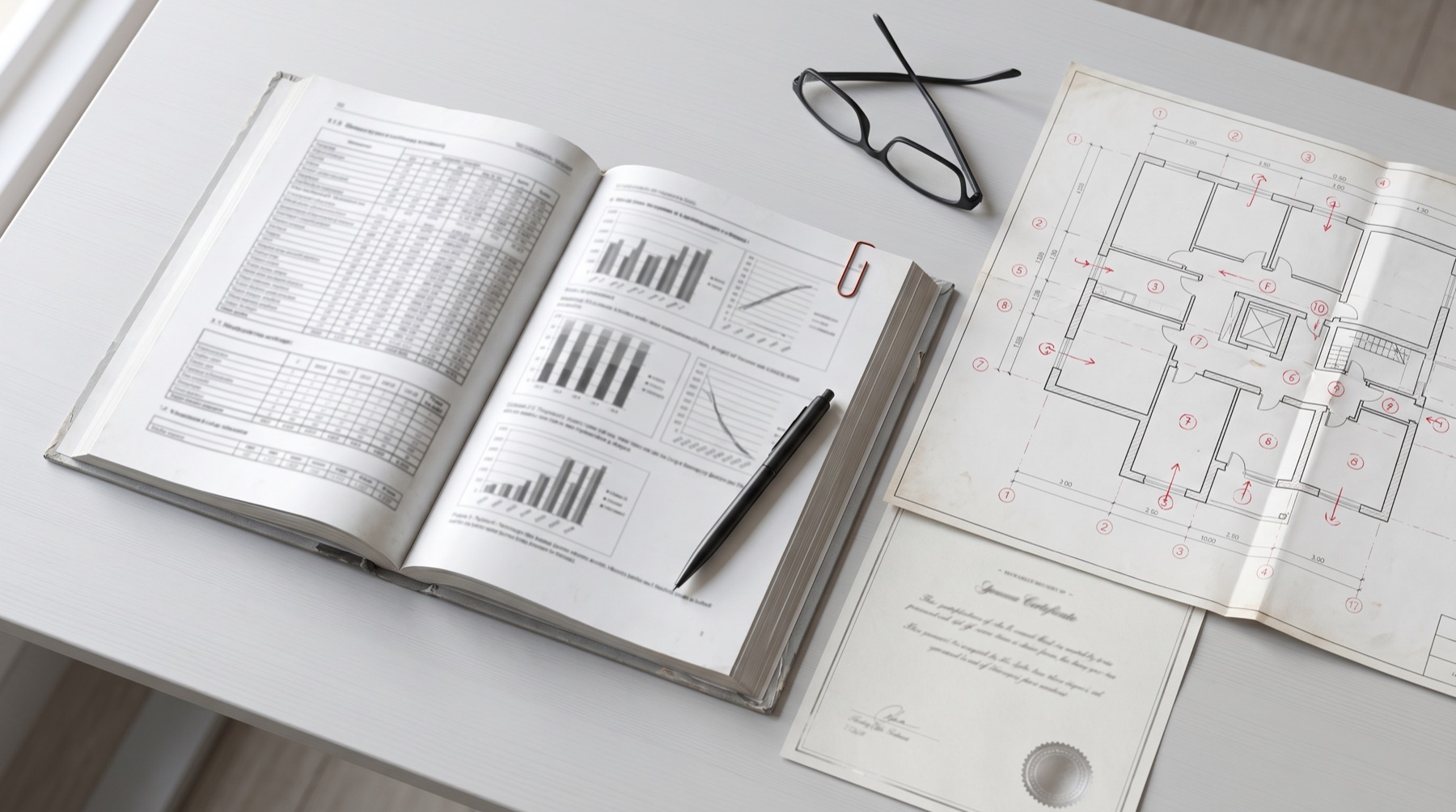
ISO 14644 explained
Particle counting
Independent editorial
Please note
This page is an editorial and informational resource about controlled
environments — what an ISO class number counts, how a particle count is actually taken, how air
is filtered and how quickly a room recovers, and how routine monitoring is trended against
limits. It is written for professional and trade readers who read facility certificates as part
of their work.
MW Labs sells nothing. It is a published editorial resource, not a shop, not a
laboratory and not a testing body. Nothing here is an offer, and no order can be placed through
this site. The practices described are general explanations of common industry procedure — not
a substitute for the current text of a standard, or for a qualified engineer's judgement about
a specific facility.
Nothing on this page is guidance on the selection, preparation or end use of any material, and
no claim of any kind is made or implied about what any material does. This resource is written
for readers aged 21 and over.
In this guide
What you will find on this page
What the class means
The ISO 14644-1 scale, what it counts, at which particle size, and why a class number alone says very little.
Taking the count
Sample volumes, how many locations a room needs, and the occupancy state that makes or breaks the result.
Air and pressure
Filter grades, air change rates, recovery time, and what a pressure cascade is supposed to prove.
Monitoring and red flags
Alert versus action limits, what routine monitoring is for, and eight failures worth catching on a certificate.
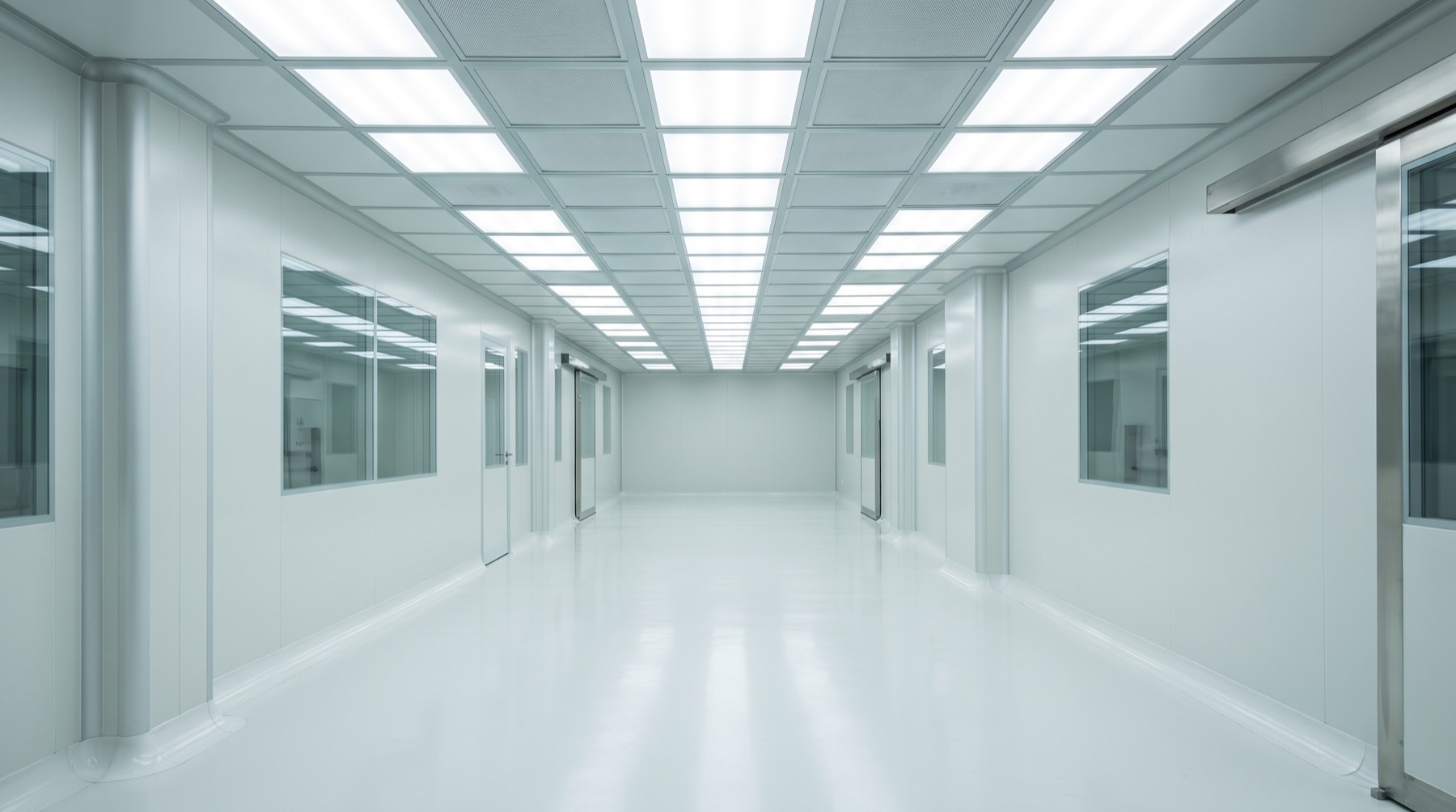
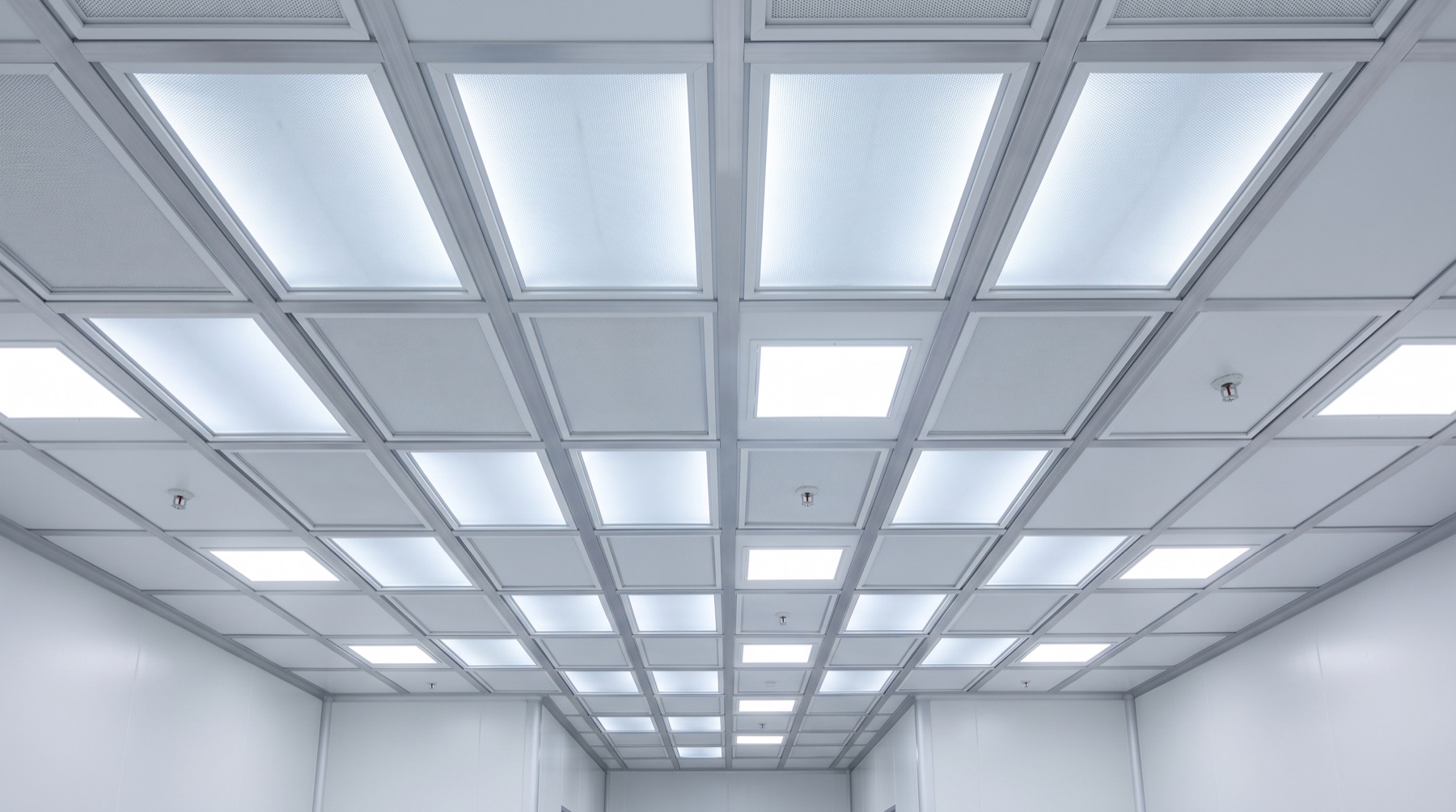
A cleanroom is not a sealed box. It is a room that is continuously flushed — the ceiling is the machine, and the class number is the result of how well it works.
Reference guideMW Labs editorial3 September 2026
Controlled environments: how a cleanroom is classified, monitored and requalified
A cleanroom is not a clean room. It is a room with a number attached, and the number is a
count — how many airborne particles above a stated size were found in a cubic metre of
air, under stated conditions, on a stated day, by a calibrated instrument. Everything that makes
the number meaningful sits in those qualifiers, and almost every argument about facility quality
turns out to be an argument about one of them.
This guide walks through the parts of that sentence in order: what the class scale actually
counts, how a count is taken and how many places it has to be taken from, what the air handling
has to do to keep it there, why the people in the room are the dominant variable, and how the
routine monitoring programme differs from the classification itself. It is a reading guide, not
a design manual — the aim is that a certificate handed to you stops being a logo and a pass mark
and starts being a document you can interrogate.
1. What the class number counts
The international scale is set by ISO 14644-1, which defines classes 1 through 9.
The rule behind them is simple enough to hold in your head: for class N, the permitted
concentration of particles at or above 0.1 µm is 10N per cubic metre, and the limits at
larger sizes fall away according to a fixed relationship. The practical consequence is that each
class is a factor of ten cleaner than the one below it, and that a claim always belongs to a
particle size. "Class 7" on its own is shorthand; "class 7 at 0.5 µm" is a specification.
ISO class
Max particles ≥ 0.5 µm per m³
Roughly comparable to
ISO 4
352
Photolithography, precision optics
ISO 5
3,520
Critical open handling zones
ISO 6
35,200
Support space around a critical zone
ISO 7
352,000
General controlled processing
ISO 8
3,520,000
Gowning rooms, staged material transfer
ISO 9
35,200,000
Ordinary indoor air, controlled access
Limits shown at the 0.5 µm threshold, the size most often quoted. The same class also carries
limits at other sizes, and a room can pass at one threshold while sitting close to the limit at
another. Read the whole row, not the headline.
Two numbers in that table are worth pausing on. The step from ISO 8 to ISO 5 is a thousandfold
reduction, which is not achieved by cleaning harder — it is achieved by moving far more air
through far better filters, in a different airflow pattern, with different rules about who may
stand where. And ISO 9 is still a classification: unfiltered indoor air in a tidy office is
roughly that, which is a useful reminder that "classified" and "clean" are not synonyms.
2. The occupancy state is half the claim
The same room yields three different results depending on what is happening inside it, and the
standard names all three:
As-built. Construction complete, services running, no equipment installed
and no people present. The cleanest number the room will ever produce, and the least
informative.
At-rest. Equipment installed and running, no personnel present. This is the
state most certificates are issued in, because it is repeatable.
Operational. Equipment running and staff working in the defined manner. This
is the only state that describes the room you actually use.
A class stated without its occupancy state is an incomplete claim, and the gap between at-rest
and operational in the same room is routinely one full class or more. When a certificate says
"ISO 7" and a monitoring log from the same week reads worse, the two are usually not in conflict
— they were taken in different states. The question to ask is not which number is right, but
which state the room was in when the process it supports was running.
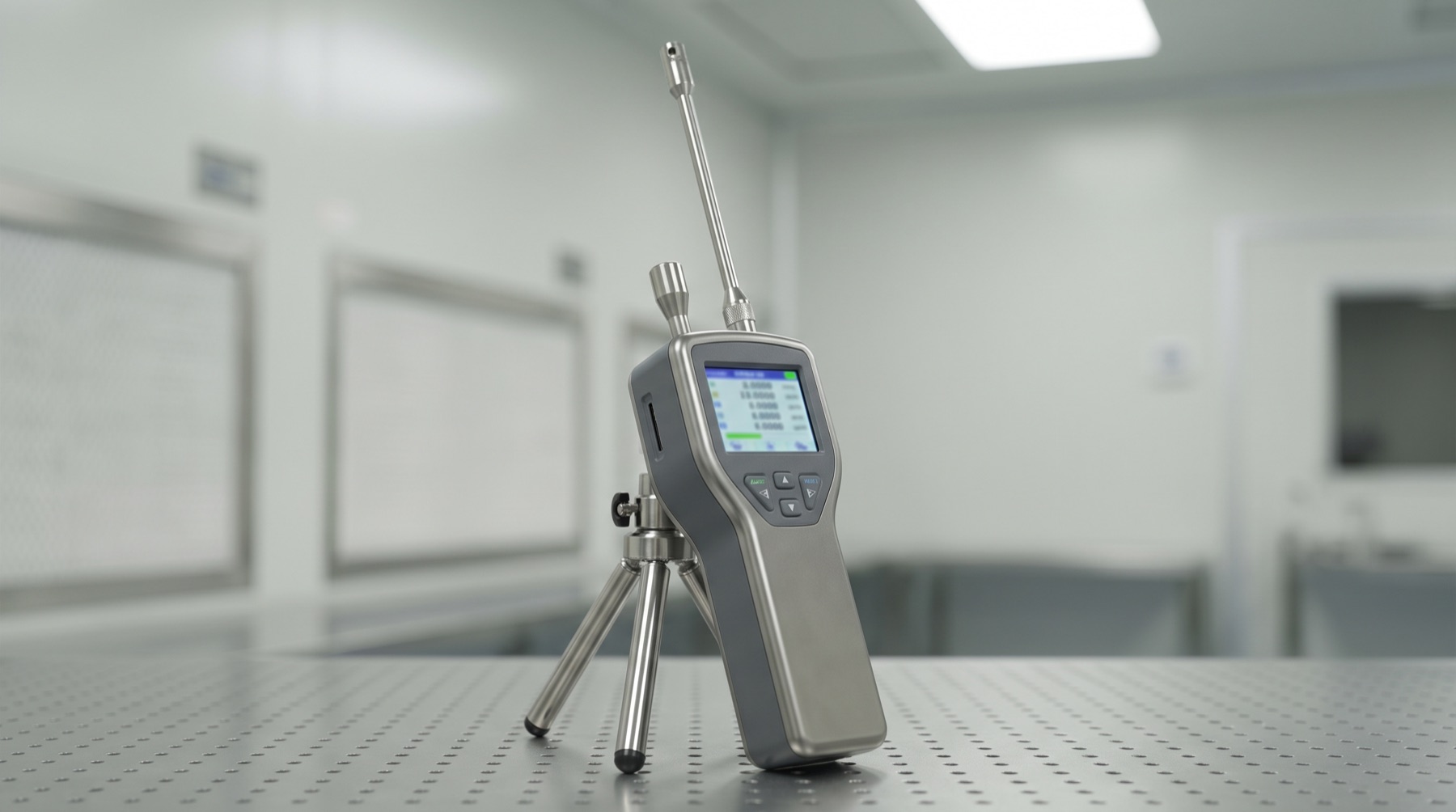
An optical particle counter sizes each particle by how much light it scatters. It counts what reaches the probe, which is why probe position, height and orientation are part of the measurement.
3. How the count is actually taken
Classification is done with a discrete optical particle counter: air is drawn
through a chamber at a known flow rate, each particle crossing a laser scatters light, and the
instrument sizes it by the intensity of that scatter and bins it into channels. Three practical
consequences follow.
Sample volume
The volume at each location has to be large enough that the class limit would produce a
statistically meaningful count — the standard sets it so that at least 20 particles would be
expected at the limit, with a floor of two litres and at least one minute per location. In a very
clean room that arithmetic gets punishing: at ISO 5 limits it means a substantial sample at every
point, and at ISO 4 or better a single location can take many minutes. A survey that finished
suspiciously quickly is worth a question.
Number of locations
The count has to be spread across the room, not taken from the most convenient corner. The 1999
edition set the minimum as the square root of the floor area in square metres, rounded up; the
2015 revision replaced that with a lookup table that generally asks for more locations and adds a
confidence treatment for small rooms. Either way, locations are distributed to represent the whole
space and are measured at working height — the height at which the work actually happens,
not wherever the tripod stands most easily.
What the 2015 revision removed
The older edition applied a 95 % upper confidence limit to the mean when fewer than ten locations
were sampled. The 2015 revision dropped that treatment and changed the location table instead.
This matters when comparing certificates across years: two documents can describe the same room,
pass the same class, and have been produced under materially different statistics. A certificate
that does not name the edition it was issued against is harder to compare than it looks.
4. Air: filters, change rates and recovery
The class number is an outcome. The air handling is the mechanism, and it does three separable
jobs: it removes particles from the supply, it dilutes what is generated inside, and it sweeps
the room clean again after a disturbance.
Filtration. HEPA filters are specified against their most penetrating particle
size — the size that slips through most easily, typically around 0.1 to 0.3 µm — and are commonly
quoted at 99.97 % efficiency at 0.3 µm, with ULPA grades an order of magnitude tighter. A filter's
rating is a laboratory figure for the medium; what matters in a ceiling is whether the installed
filter and its seal leak. That is a separate test: the filter face and frame are scanned
with a probe while an aerosol challenge is introduced upstream, and penetration above a small
fraction of a percent counts as a leak to be repaired, not averaged away.
Airflow pattern and change rate. Turbulently ventilated rooms dilute: air enters
from ceiling diffusers, mixes, and leaves through low-level returns, with cleanliness a function of
how many times per hour the volume is replaced. Unidirectional rooms sweep instead: a full ceiling
of filters pushes air down as a moving blanket, conventionally in the region of 0.45 m/s, and
particles are carried away rather than mixed in. The two strategies produce very different air
change figures for the same class, which is why an air change rate quoted without an airflow
pattern tells you almost nothing.
Recovery. Of all the performance tests, recovery is the one that best predicts
how a room behaves on a bad day. A controlled disturbance raises the particle concentration, and
the time taken to fall back by a factor of one hundred is measured. A room that classifies well
at rest but takes half an hour to recover is a room where a single door event costs you the rest
of the operation. If a certificate contains a classification and nothing else, recovery is the
first thing to ask for.
5. The pressure cascade
Cleanliness is also maintained by direction. Adjacent spaces are held at deliberately different
pressures so that leakage across a doorway always runs from the cleaner side to the dirtier one,
commonly with a difference in the region of 10 to 15 pascals between grades, and airlocks between
the biggest steps. Where the hazard runs the other way — work that must be contained rather than
protected — the cascade is deliberately reversed, and the airlock becomes a sink rather than a
source.
The failure mode is rarely the design; it is the moment the design stops being true. A propped
door, a return grille blocked by a pallet, a new machine with its own extract, a filter loading up
toward the end of its life — each quietly flattens or inverts a differential that a drawing still
shows as correct. A gauge on the wall records the present instant. A logged differential,
trended over weeks, records the room. Only one of those two can tell you when it changed.
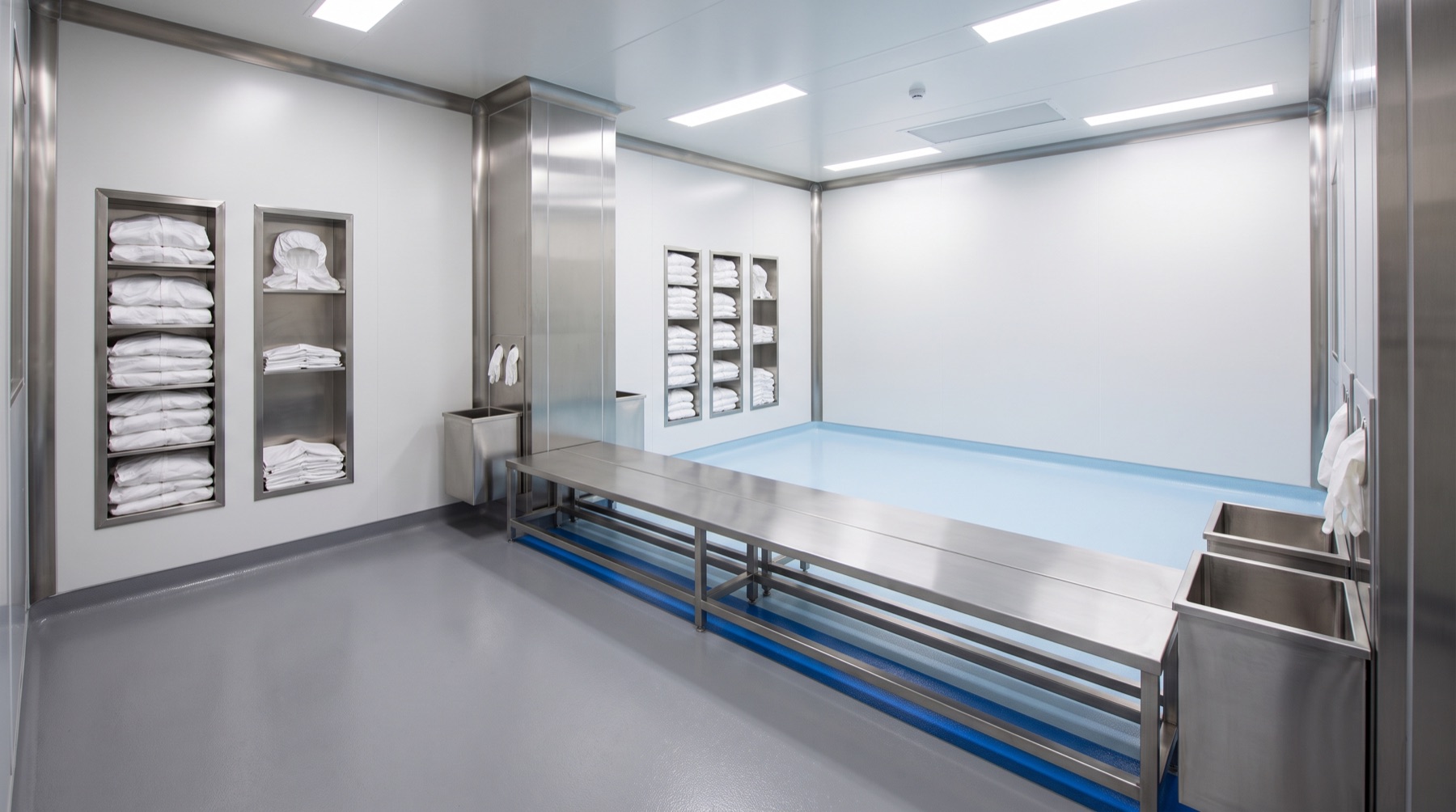
The step-over bench exists because gowning is a sequence, not a costume. Its order — and the point at which the floor becomes clean — is the part most often abbreviated under time pressure.
6. People are the source
In an occupied room, the dominant particle source is almost always the people in it. A person in
ordinary clothing sheds skin scales and fibres continuously, at rates measured in the hundreds of
thousands to millions of particles per minute while moving, and a substantial fraction of what a
gowning regime achieves is simply keeping that inside a garment. Correct gowning cuts the figure
by orders of magnitude; the same garment donned in the wrong order, or touched on the outside on
the way in, gives back much of the gain.
Three behavioural variables move the numbers more than most equipment decisions:
Sequence. Gowning runs from the cleanest item outward, with a defined
step-over point and a glove change at the end. Written down and audited, it holds. Learned by
watching a colleague, it drifts within months.
Movement. Fast movement generates and re-entrains particles; walking past an
open critical zone can disturb a unidirectional flow that took a ceiling full of filters to
establish. Cadence is part of the specification even when nobody has written it down.
Transfer. Every item entering the room brings its own load. Staged
wipe-down, outer-layer removal at the airlock and a rule about corrugated cardboard do more for
a room's operational count than another few air changes.
This is also the honest answer to why operational counts diverge from at-rest ones, and why the
gap is not a defect to be explained away. It is the room telling you what your process costs it.
7. Monitoring is not classification
Classification is a periodic, formal exercise against a standard. Monitoring is
the routine programme that runs in between, and it answers a different question: not "does this
room meet its class" but "is this room behaving the way it did last month". Confusing the two is
the most common misreading of a facility file.
Monitoring is usually split into two streams. Non-viable monitoring counts
particles, often continuously at fixed critical points, with alarms. Viable
monitoring looks for organisms rather than particles: settle plates left exposed for a defined
period to capture what falls, contact plates pressed to surfaces and gloves, and active air
samplers that draw a known volume of air onto a plate so that a result can be expressed per cubic
metre rather than per exposure. Temperature, humidity and pressure differentials are logged
alongside, because they explain the excursions.
Alert limits and action limits are not the same thing
An action limit is a specification: exceed it and a defined response is
triggered, investigated and documented. An alert limit sits below it and is a
statistical early warning derived from the facility's own historical data — it says "this room is
no longer behaving like itself", which is often visible weeks before anything approaches the
specification. Alert limits copied from a textbook, or set equal to the action limit, throw that
warning away. When reviewing a monitoring plan, the question worth asking is where the alert
limits came from and when they were last recalculated.
The value of monitoring is entirely in the trend. A single excursion is an event. Three
excursions at the same location in a quarter, or a slow upward drift in a background count that
never once breached a limit, is information — and it is exactly the kind that a file of individual
pass/fail results will hide.
8. Requalification and change control
Classification expires. Under ISO 14644-2 the room is reclassified at defined intervals — commonly
every six months for the cleanest grades and annually for the rest — and the interval assumes the
room has not materially changed in between.
Change is what breaks that assumption, and it rarely announces itself. A bench moved a metre, a
new instrument with its own heat load, a replacement filter of a different make, a revised gowning
supplier, an extra person added to the shift: each is small, none is obviously a facility change,
and together they can move a room off its qualified state without a single document being raised.
A change-control step that explicitly asks whether the environment was affected is what turns a
stack of certificates into a continuous claim.
The documentation package that comes out of a requalification is where all of this becomes
checkable. A complete one names the standard and its edition, states the occupancy state, lists
every sampling location and its result, identifies each instrument by serial number with its
calibration date, records the supporting tests — filter integrity, airflow, differential pressure,
recovery — and closes with any deviations and their disposition. A one-page certificate with a
class and a signature is a summary of that package. It is not a substitute for it, and a facility
that cannot produce the underlying data on request has told you something.
The certificate is the summary. The floor plan with numbered sampling points, the instrument calibration certificates and the deviation log are the evidence — and they are what a serious review asks for.
9. Eight things worth checking
None of the following is proof of a problem on its own. Each is a reason to ask one more question.
A class with no occupancy state. "ISO 7" without at-rest or operational is an
incomplete claim, and the difference between the two is often a full class.
No instrument identified. A count is only as good as the counter. Serial
number and calibration date belong on the certificate, and a calibration that expired before the
survey date invalidates it.
Too few sampling locations for the floor area. Count the points on the plan
and compare against the area. This is the easiest thing on the list to verify and the most
frequently thin.
No recovery test. A room can classify beautifully at rest and take far too
long to clear after a disturbance. If recovery was never measured, nobody knows.
Filter integrity reported as an average. Leak scanning finds local defects at
seals and frames. An area-averaged efficiency figure is the wrong test reported in the wrong
units.
Alert limits equal to action limits. A near-certain sign the limits were
copied rather than derived, and that the early-warning function has been switched off.
Pressure differentials recorded by hand once a shift. Twice-daily spot values
cannot show a drift, and a drift is the failure you are looking for.
A certificate that predates a visible change. If the room contains equipment
the report does not mention, the report describes a different room.
10. A ten-point review checklist
A practical order for working through a facility file, arranged so the cheap checks come first:
Which standard and which edition was the classification performed against?
Which occupancy state, and does it match the state the process runs in?
Which particle sizes were reported, and how close is each to its limit?
How many sampling locations, and does that match the floor area?
What sample volume and time per location, and is the count statistically meaningful at the class limit?
Which instrument, and was its calibration current on the day?
Are the supporting tests present — filter integrity, airflow, differential pressure, recovery?
Do the monitoring limits distinguish alert from action, and when were the alert limits last derived from actual data?
Is there a trend, not just a folder of individual results?
When is requalification due, and has anything changed in the room since the last one?
Ten questions is not an audit. But a facility that answers all ten without hesitation is a
facility that keeps its own records for its own use, rather than for the visitor — and that
distinction is usually visible within the first three.
About this guide. It describes general, widely published industry practice for
classifying and monitoring controlled environments, and is written for trade and professional
readers. Standards are revised; where a figure matters to a decision, read the current text of the
standard itself. Nothing here is advice about any particular facility, and MW Labs neither
classifies rooms, issues certificates nor sells anything.
More about MW Labs
Who publishes this resource, why it exists, and how to reach the editor with a correction or a question about the guide.
MW Labs is an editorial resource on controlled environments and the documents that describe
them. It exists because the questions worth asking about a facility certificate are almost
always the same ones — against which edition, in which occupancy state, from how many locations,
with which instrument, and what has changed since — and they are easier to answer once,
properly and in public, than one conversation at a time.